Just now I was looking through some photos I had recently taken on my iPad. One was a cut out page from The Age Good Weekend magazine, folded in half, laid on top of various random folders in my office, waiting for me to review some interesting comments in the article.
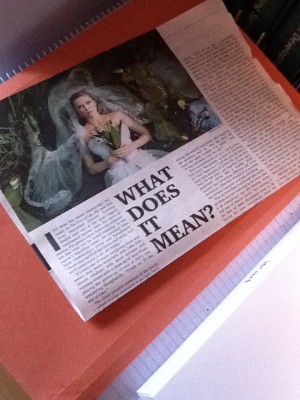
The Veil – spontaneous composition
After taking this photo, I remember looking around me to see what else I could photograph.
I photographed a painting on my wall which I had painted perhaps 7 or 8 years ago, I don’t remember exactly.
This is the photo of the painting. (see below)
At the time of taking the photo I was definitely not thinking of the similarity between the two photos or images. Yet now, I find the connection rather interesting.
Both are images of a veil, in fact The Veil was the title I had for the painting.
What is also notable is the fact that the two main background colours behind the veiled image are orange and olive/dark green, though in a different arrangement. (The painting obviously wasn’t framed perfectly in the photo, adding a graphic `underline’ element which links in with the elements in the other photo.)
Further, the words seem to comment on the mystery of the painting.

The Veil by Rainer Rollfink
Synchronicity, as I see it, was a term coined by Carl Jung to embrace the idea of `a meaningful coincidence’. It gives us permission to leave the hard rational world to find some magic in our daily life, to find some mysterious thread that runs through it, even if we can only trace it for a short span of time. It opens up doors of artistic appreciation, of the connections that shed light on each other’s meaning or meaningfulness. It allows us to embrace diverse experiences into the wholeness of a life, to appreciate things, objects, experiences from different angles than we may have previously. Perhaps even spark some creative responses to the life we live.
© R Rollfink 2011
To read the next article in this series, Synchronicity: Example 2 follow this link